How to Pass the Oklahoma DMV Exam 2026
Step 1: Confirm Eligibility and Gather Your Documents
Make sure you qualify before you begin
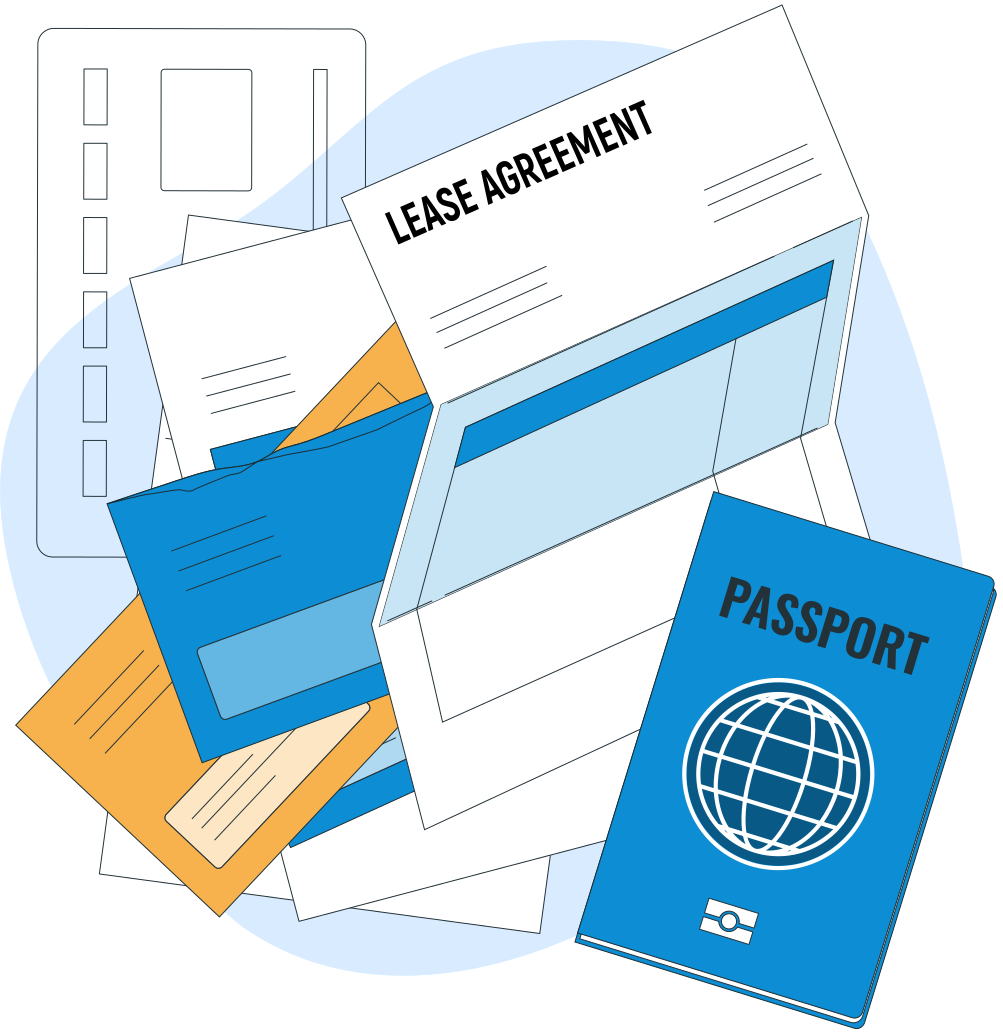
Oklahoma licenses drivers through Service Oklahoma, working with the Department of Public Safety. You may apply for a Class D learner permit at 15 if you are taking or have completed an approved driver education course, or at 16 without driver education. Gather your paperwork before you visit so your trip is not wasted.
- One proof of identity and lawful presence, such as a certified birth certificate or an unexpired U.S. passport
- Your Social Security number
- One proof of Oklahoma address, or two documents if you want a REAL ID credential
- Your driver education completion certificate or enrollment contract if you are applying at 15
- Proof of liability insurance for any vehicle you bring to a test
If you are under 18, a parent or legal guardian must come with you to sign your application, or you must bring the notarized authorization form. Bring originals or certified copies rather than photocopies.
Step 2: Decide Whether You Need Driver Education
Driver education changes your timeline, not just your skills
Oklahoma does not force every applicant into a driver education course, but taking one lets you start a full year earlier and reach an unrestricted license sooner. Choose the path that fits your age and schedule.
- With approved driver education: learner permit at 15, intermediate license at 16
- Without driver education: learner permit at 16, intermediate license at 16 1/2
- Applicants 18 and older can apply for a Class D learner permit or license with no driver education requirement
- Oklahoma recognizes commercial schools, public school programs and the state-approved Parent-Taught Driver Education Program
If you use the parent-taught program, bring the Service Oklahoma approved Parent-Taught Affidavit and a purchase receipt for the course. Applicants under 18 also need the free online Oklahoma Work Zone Safe completion certificate before an intermediate license is issued.
Step 3: Study the Official Oklahoma Driver Manual
Every exam question comes from the manual
The written test is drawn directly from the Oklahoma Driver Manual published by Service Oklahoma, so studying it is the single most useful thing you can do. Read it chapter by chapter rather than skimming.
- Learn the sign shapes and colors, traffic signals and pavement markings
- Memorize Oklahoma's numbers: 75 mph on controlled-access highways, 80 mph on turnpikes, 65 mph on undivided state highways, the three-second following distance and the 100-foot turn signal rule
- Review the parking distances: 15 feet from a fire hydrant, 20 feet from a crosswalk at an intersection, 30 feet from a stop sign or signal, and 50 feet from the nearest rail of a railroad crossing
- Know the state-specific rules: the 25/50/25 insurance minimums, the 0.08 BAC limit with zero tolerance for drivers under 21, and the Move Over or Bernardo-Mills Law
Work through Oklahoma practice tests until you are scoring well above the passing mark, and pay extra attention to any question you miss twice.

Step 4: Pass the Vision and Written Tests to Get Your Learner Permit
Take the exams and start the graduated program
You take a vision screening at a Service Oklahoma location and the written knowledge exam either in person or online through the Know2 Drive platform. Results are given immediately.
- The written test has 20 multiple-choice questions and you must answer 15 correctly, so no more than 5 mistakes
- You have 60 minutes to complete the test
- The online exam has no extra fee and may be attempted twice; after two failures you must test in person
- A fee is charged for each failed attempt and is collected when your license is issued
- If you need glasses or contacts to meet the vision standard, a corrective lens restriction is added to your license
Once you pass both tests your Class D learner permit is issued and Oklahoma's Graduated Driver License program begins for you.

Step 5: Practice Driving and Log Your Supervised Hours
Build real experience behind the wheel
You must hold your learner permit for at least 180 days before you can move up to an intermediate license. Use that time deliberately, driving in a range of conditions rather than only on familiar routes.
- A learner permit is valid only while a licensed driver at least 21 years old is sitting beside you
- Permit holders may drive between 5:00 a.m. and 10:00 p.m.
- Complete at least 50 hours of behind-the-wheel driving, with at least 10 of those hours at night
- Your supervising driver must be licensed, at least 21 and have at least two years of driving experience
- You must have no traffic convictions in the 180 days before you test
Keep an honest log as you go. Practice night driving, highway merging, rain, parallel parking and hill starts, because those are exactly the situations that catch new drivers out on the road test.

Step 6: Pass the Drive Test and Learn Your Intermediate Restrictions
Prove you can drive safely, then drive within the rules
A Service Oklahoma driver examiner rides with you and scores how well you control the vehicle and apply the rules of the road. You supply a safe, registered vehicle with valid proof of liability insurance in it.
- Expect smooth starting and stopping, signaling at least 100 feet before turns, mirror and blind-spot checks, lane changes, intersections, backing, turning around, parallel parking and starting on a hill
- You can fail for too many errors, dangerous driving, a law violation, a collision or refusing a maneuver
- You may take the drive test three times after becoming eligible; after that you can test only once every 30 days
- With the intermediate license you may drive alone only between 5:00 a.m. and 10:00 p.m.
- You may carry only one passenger unless the passengers live in your home or a licensed driver 21 or older is in the front seat
The hour restriction does not apply when you are traveling to or from school, church or work activities, or when a licensed driver 21 or older is in the front seat with you.

Step 7: Get Your Unrestricted Oklahoma License and Stay Insured
Remove the restrictions and drive responsibly
Once you have driven safely on the intermediate license for long enough, Service Oklahoma removes the restrictions and you hold a full Class D driver license.
- With driver education: restrictions can be removed after six months on the intermediate license, with a clean record for the preceding 180 days
- Without driver education: you must hold the intermediate license 12 months and go 12 months without a conviction
- A license issued to anyone under 18 is probationary, so a conviction carries extra consequences
- Carry at least Oklahoma's minimum liability insurance: $25,000 for injury or death of one person, $50,000 for two or more people and $25,000 for property damage, per accident
- Keep your security verification form in the vehicle and show it whenever an officer asks
Keeping your license
Your driving record follows you. Under the Mandatory Point System, accumulating 10 or more points within five years suspends your license, and failing to stop for a school bus with its red lights flashing brings a mandatory one-year revocation. A BAC of 0.08 or more revokes your privilege under the Implied Consent Law, and for drivers under 21 any measurable amount of alcohol does the same.
- An Oklahoma license is issued for either 4 or 8 years and expires on the last day of the month
- You can renew up to one year before the expiration date, often online
- Notify Service Oklahoma within 10 days whenever you change your address
Fees and document requirements change from time to time, so confirm the current rules before your visit: Service Oklahoma — oklahoma.gov/service
These links should help guide you through the application and testing process. Each official state agency page contains the latest requirements and resources to ensure you have everything needed to obtain your Oklahoma driver’s license.

