How to Pass the Nevada DMV Exam 2026
Step 1: Confirm Eligibility and Gather Your Documents
Make sure you qualify before you begin
Nevada licenses drivers through the Department of Motor Vehicles (DMV). You may apply for an instruction permit once you turn 15½, and for a full driver's license at 16. Gather your paperwork before you visit a DMV office so your trip is not wasted.
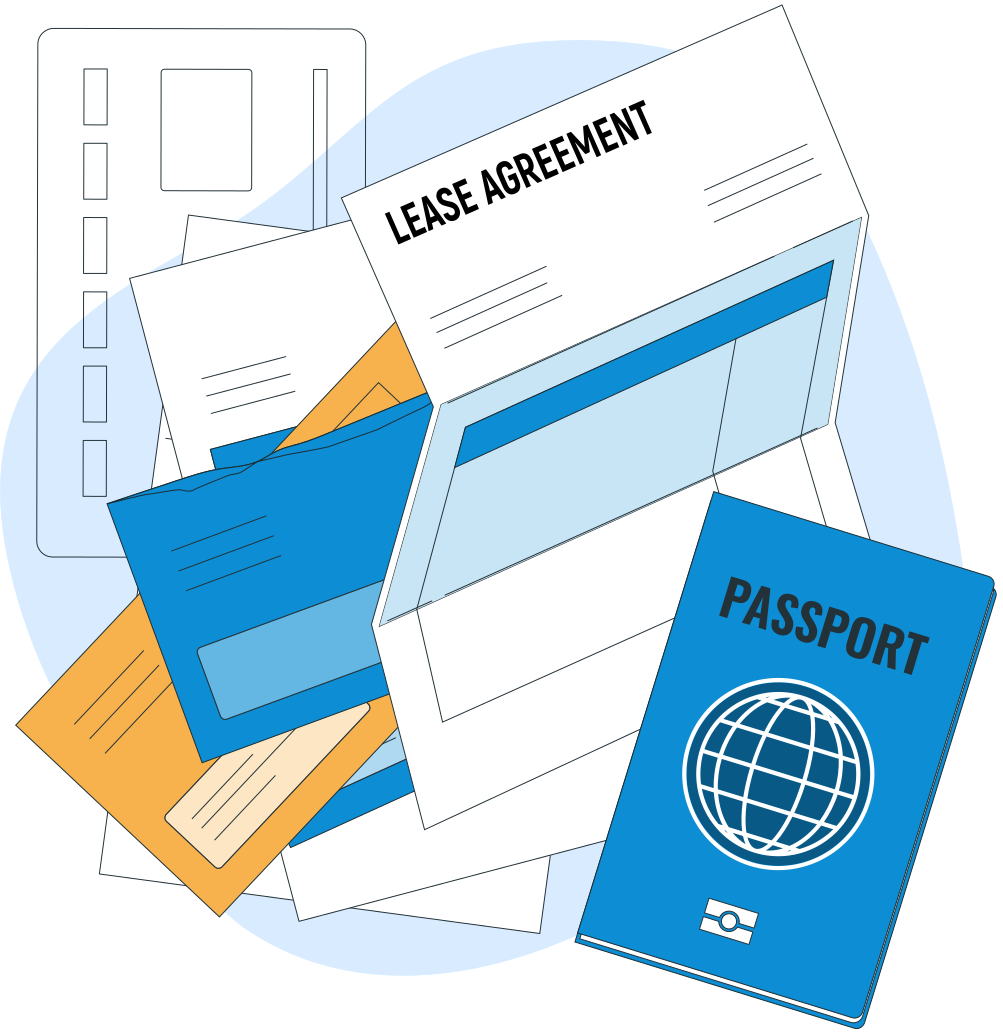
- Proof of full legal name and date of birth, such as a certified state birth certificate or valid U.S. passport
- Evidence of your Social Security number: a Social Security card, W-2, IRS Form 1099, or printed paystub showing the full number
- Two original or certified documents proving your Nevada residential address, such as a utility record, bank statement, lease, or rent receipt
- If you are under 18, a Certification of Attendance (DMV 301) signed by a school official, dated within the previous 60 days
If you are under 18, a parent, legal guardian, or other person authorized by NRS 483.300 must co-sign your application, and that co-signer shares liability for damages caused by your negligence while driving.
Step 2: Study the Official Nevada Driver's Handbook
Prepare for the knowledge test
The Nevada knowledge test is written directly from the official Nevada Driver's Handbook published by the DMV. Every question comes from that manual, so studying it is the single best preparation you can do.
- Learn the sign shapes and colors, traffic signals, and pavement markings
- Memorize the Nevada numbers: the two-second minimum following distance, the 100-foot city and 300-foot highway signal rule, the 18-inch curb parking rule, and the 15 or 25 mph school zone limits
- Review Nevada-specific rules such as the 0.02% limit for drivers under 21, the 25/50/20 insurance minimums, the 12-point suspension threshold, and the requirement to stop at any location for a school bus flashing red lights
Work through Nevada practice tests until you consistently score above 80%, and pay special attention to any question you get wrong twice.
Step 3: Pass the Vision and Knowledge Tests
Take the tests that unlock your permit
Every applicant takes a vision test, and beginning drivers must pass the knowledge test. Nevada lets you take the written exam either online from home or in a DMV office on a touch-screen computer.
- The Class C knowledge test has 25 multiple-choice questions and 80 percent is passing, meaning 20 correct answers and no more than five mistakes
- The test stops as soon as you reach 20 correct answers or six incorrect ones
- The vision standard is 20/40; if you need glasses or contacts to reach it, Restriction B is added to your license and you must wear them whenever you drive
- A $25 fee covers the initial testing, and each retest costs $10
The exam is offered in English and Spanish, with an audio option in DMV offices. Online testing through KnowTo Drive Nevada requires a computer with a front-facing camera, since touch-screen devices are not supported. Your passing result is valid for one year.

Step 4: Get Your Nevada Instruction Permit
Start practicing legally
Once you pass the vision and knowledge tests, you can be issued a Nevada instruction permit. The permit is valid for one year and you must carry it with you whenever you drive.
- You must be at least 15½ years old and have a parent or guardian available to authorize issuance
- While driving, you must be accompanied by a licensed driver who is at least 21 years old, has at least one year of licensed driving experience, and is seated beside you
- If you are under 18, you must hold the permit for at least six months before applying for a driver license
- The instruction permit fee is $22.50
Adults 18 and older may skip the instruction permit and go straight to the road test if they prefer, though without a permit you cannot schedule the drive test appointment online and must schedule it in person at the office.

Step 5: Complete Driver Education and Log Your Practice Hours
Build real experience behind the wheel
Most first-time drivers under 18 in Nevada must complete a driver education course before the drive test. You may take it at a DMV-approved school locally or online through a DMV-approved provider.
- Teens within 30 miles of a DMV-approved driver's education school must complete 50 hours of supervised behind-the-wheel experience, 10 of which must be at night
- If you live more than 30 miles from an approved school and cannot access an online class, you must instead complete 100 hours of behind-the-wheel experience, 10 of them in the dark
- Record every session in the official Beginning Driver Experience Log, DMV Form DLD-130, completed in blue or black ink before you arrive for the drive test
Minors must also remain free of any at-fault crashes, moving violation convictions, and any alcohol or drug conviction for the six months before receiving a driver's license, so drive carefully during this period.
Step 6: Pass the Road Skills Test
Prove you can drive safely
Skills tests are given by appointment, and you must pass the knowledge test and hold an instruction permit for your license class before you can schedule online. Have your instruction permit number ready when you book.
- The examiner first inspects your vehicle: registration, evidence of insurance, headlights, taillights, brake lights, turn signals, horn, seat belts, tires, and windshield wipers must all be in good working order
- You will be tested on preparing to drive, vehicle control, entering traffic, lane use, speed control, turns, parking, backing up, stopping, passing, and attention to traffic situations, and you may be asked to demonstrate stopping on a grade
- Passengers and animals are not allowed in the vehicle, and you may not use a rental car
- Using a cell phone during the drive test results in automatic failure, and you may not use features such as parking assist or cruise control
You will never be asked to violate a traffic law during the test, and you will be penalized if you do.

Step 7: Receive Your Nevada Driver's License and Get Insured
Get licensed and drive responsibly
Once you pass the road test and meet all remaining requirements, the DMV issues your Nevada driver's license. An original eight-year non-commercial license costs $41.50, and licenses issued to drivers 65 and older are valid for four years.
- Carry at least Nevada's minimum liability insurance of 25/50/20: $25,000 for bodily injury or death of one person, $50,000 for two or more people, and $20,000 for property damage
- Your Evidence of Insurance Card must be carried in the vehicle at all times, or be available electronically on a mobile device
- If you are licensed at 16 or 17, you may not carry passengers under 18 other than immediate family for your first six months, and as a minor you may not drive between 10 p.m. and 5 a.m. unless traveling to or from a scheduled event
- Notify the DMV of any address or name change within 30 days, and remember that 12 or more demerit points in a 12-month period will suspend your license
Keep your record clean: most violations are reportable to your insurance company for three years, and DUI convictions stay on your Nevada driving record for seven.
These links should help guide you through the application and testing process. Each official state agency page contains the latest requirements and resources to ensure you have everything needed to obtain your Nevada driver’s license.

